Professional Training for Clinical & Wellness Practice
Become a certified aromatherapist in 2-4 weeks. Learn 32 essential oils, safety protocols, blending techniques, and clinical applications. ISO 9001:2015 certified program.
Start your certification today for only $99.99The global wellness industry reached $1.5 trillion in 2023, with aromatherapy representing one of the fastest-growing segments. Certified aromatherapists work in hospitals, spas, private practices, and wellness centers, or build product-based businesses.
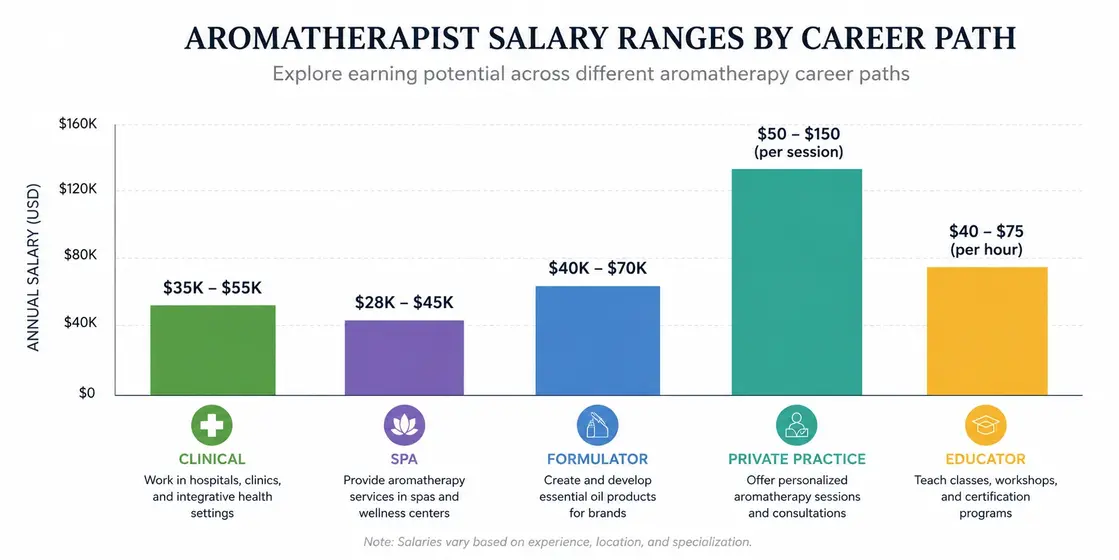
Some integrative healthcare programs and wellness departments incorporate aromatherapy services as part of complementary care. Clinical aromatherapists earn $35,000-$55,000 annually, working alongside nurses and physicians. Many RNs and LMTs add aromatherapy certification to expand their practice scope.
Aromatherapy may be incorporated into integrative wellness, massage therapy, nursing, hospice, and complementary healthcare settings. Because the U.S. Bureau of Labor Statistics (BLS) does not track aromatherapists as a separate occupation, earnings vary depending on professional licensure, healthcare background, geographic location, and employment setting. Related wellness professions such as massage therapists reported median annual earnings of approximately $57,950 according to recent BLS data.
Spa and wellness professionals may incorporate aromatherapy into massage, esthetics, relaxation, and wellness services. Compensation varies based on location, clientele, experience, commissions, and whether aromatherapy is combined with licensed services such as massage therapy or skincare.
Independent aromatherapists see clients for custom blends, wellness plans, and education. Session rates range from $50-$150 depending on location and specialization. Many practitioners build sustainable practices serving 10-20 clients per week.
Independent aromatherapy practitioners may offer consultations, wellness education, custom blending services, and related wellness support. Because many practitioners are self-employed, income varies significantly depending on specialization, geographic market, client volume, pricing structure, and whether aromatherapy is combined with another licensed wellness profession. Many practitioners build sustainable practices serving 10-20 clients per week.
Professionals with aromatherapy knowledge may work in wellness product development, cosmetic formulation, or natural products businesses. Earnings vary depending on formulation expertise, manufacturing experience, company size, retail distribution, and business ownership structure.
Experienced aromatherapists teach public workshops, corporate wellness programs, and professional training. Hourly rates typically range from $40-$75 for instruction.Experienced wellness practitioners may provide aromatherapy workshops, wellness education, or professional training programs. Compensation varies widely depending on credentials, audience type, teaching format, organizational partnerships, and geographic location.
Credential Verification: Certification demonstrates competence, builds client trust, and may be required for liability insurance. While aromatherapy is not a licensed profession in most states, professional certification is commonly preferred by employers, clients, and liability insurance providers in the wellness industry.
This comprehensive course covers essential oil chemistry, therapeutic applications, safety protocols, and professional practice standards. You'll study 32 essential oils in depth, learn evidence-based blending techniques, and understand how aromatherapy supports both physical and emotional wellness.
You'll learn the chemistry behind therapeutic effects. Each essential oil contains specific chemical constituents — monoterpenes, sesquiterpenes, esters, oxides, phenols, and aldehydes — that determine its properties and applications.
Professional aromatherapy requires a comprehensive understanding of when NOT to use specific oils. Protecting clinical vulnerabilities while tailoring treatment plans is crucial.
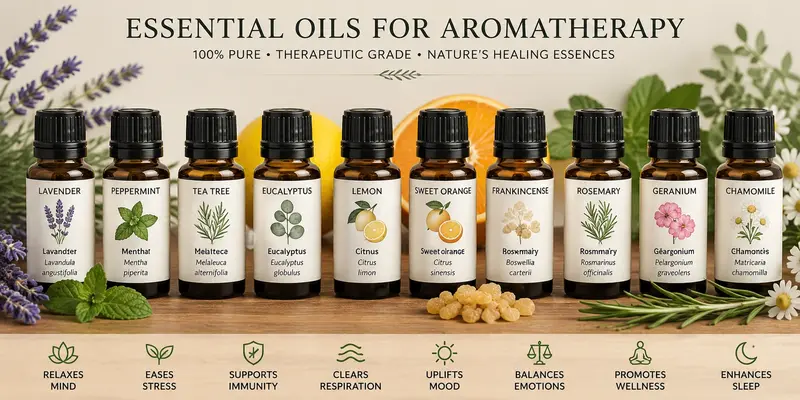
The Top 32 Essential Oils at a Glance
You'll study the most therapeutically versatile essential oils used in professional practice:
| Essential Oil | Primary Uses | Key Compounds | Safety Notes |
|---|---|---|---|
| Lavender | Relaxation, skin repair, sleep support | Linalool, linalyl acetate | Generally safe; rare sensitization |
| Tea Tree | Antimicrobial, skin conditions | Terpinen-4-ol, 1,8-cineole | Avoid internal use; toxic to pets |
| Peppermint | Headache, digestion, mental clarity | Menthol, menthone | Avoid with children under 6; dilute well |
| Frankincense | Meditation, skin aging, stress | Alpha-pinene, limonene | Generally safe; quality varies widely |
| Eucalyptus | Respiratory support, muscle tension | 1,8-cineole (eucalyptol) | Avoid with children under 10; asthma caution |
| Roman Chamomile | Calming, skin sensitivity, sleep | Esters (85% composition) | Generally safe; rare allergic reaction |
| Ylang Ylang | Stress, heart rate, mood balance | Linalool, germacrene-D | Can cause headaches; use low dilution |
| Bergamot | Mood elevation, skin conditions | Limonene, linalyl acetate | Highly phototoxic; avoid sun after application |
Plus 24 additional oils including Rosemary, Geranium, Clary Sage, Sweet Orange, Lemon, Sandalwood, Rose Otto, Neroli, Jasmine, and more. Each profile includes botanical name, extraction method, therapeutic properties, contraindications, and blending notes.
This course teaches evidence-based aromatherapy for specific health concerns:
Lavender, bergamot, and frankincense blends; application via inhalation and massage; research on cortisol reduction.
Lavender, chamomile, and vetiver protocols; diffusion timing and safety; studies on sleep quality improvement.
Peppermint, eucalyptus, and wintergreen applications; topical use for headaches, muscle tension, and joint discomfort; mechanisms of action.
Tea tree, lavender, and helichrysum for acne, eczema, and wound healing; proper dilution to avoid irritation.
Eucalyptus, peppermint, and frankincense for congestion and breathing support; steam inhalation protocols.
Peppermint, ginger, and fennel for nausea and digestive discomfort; appropriate administration methods.
Citrus oils, ylang ylang, and clary sage for emotional balance; olfactory system and limbic connection.
Professional aromatherapists conduct intake assessments before recommending oils. You'll learn:
You'll understand the legal, ethical, and business aspects of aromatherapy practice:
This aromatherapy certification is provided by ExpertRating, an ISO 9001:2015 certified company with over 25 years in online professional training. More than 25 million tests have been delivered to individuals and companies in 160 countries.
ISO 9001:2015 is an internationally recognized quality management standard. This certification confirms:
This certification is accepted by:
The National Association for Holistic Aromatherapy (NAHA) sets professional standards for aromatherapy education and practice in North America. While this course is not NAHA-approved (NAHA approval requires specific institutional criteria), this course introduces foundational aromatherapy concepts that overlap with beginner-level aromatherapy education:
NOTE: If you plan to pursue NAHA membership or advanced NAHA certification later, this course provides a strong foundation. Some aromatherapy schools may consider prior education for placement or advanced standing. Requirements vary by institution — verify with the specific school.
Dr. Donna Schwontkowski is a retired chiropractor with advanced degrees in nutrition and herbology, and over four decades of experience in natural healing and aromatherapy. She began working with essential oils in the 1980s as a massage therapist, developing deep expertise in therapeutic plant applications, blending techniques, and holistic wellness practices. Dr. Donna studied under renowned herbal educators including John Easterling and Dr. John R. Christopher, strengthening her foundation in alternative healing methods. She has taught natural healing and essential oil education to thousands of students in California, written extensively on aromatherapy for Health & Fitness Magazine, and continues researching the historical and therapeutic uses of medicinal plants and essential oils.
Professional Profile: https://www.linkedin.com/in/dr-donna-schwontkowski-66bba019/
ExpertRating is an internationally recognized provider of online certification and professional training programs. The organization is ISO 9001:2015 certified, demonstrating compliance with internationally accepted quality management standards.
As a member of the International Council for Online Educational Standards (ICE), ExpertRating adheres to rigorous benchmarks for quality assurance, ethical practices, and continuous improvement - ensuring that every course and certification is delivered with integrity and professional excellence.
Always verify with your licensing or certifying body before enrolling if you need this for CE credit. We provide a certificate and course transcript showing 30-40 study hours upon completion.
This certification is designed for working professionals who need flexibility. You study online at your own pace, with no scheduled class times or deadlines.
Immediate Access
Enroll and start learning within minutes. All course materials are available instantly upon registration. No waiting for class start dates.
Self-Paced Study
Most students complete the course in 2-4 weeks studying 1-2 hours per day. You can move faster or slower based on your schedule and learning style.
Lifetime Course Access
Unlike courses that lock you out after completion, you have lifetime access to all materials. Refresh your knowledge anytime, even years after certification.
Each module includes text lessons, essential oil monographs, safety charts, and formulation guides. All materials are downloadable for offline reference.
Instructor Email Support
Have questions while studying? Email our instructors and receive responses within 24 hours (usually faster). Support is available 7 days a week.
Study Guides
Each module includes review questions and key takeaways to reinforce learning. Use these to prepare for the certification exam.
Reference Materials
Download safety charts, dilution calculators, and essential oil quick-reference guides for professional practice.
Format
Online exam with 40 multiple-choice questions. Time limit: 40 minutes.
Passing Score
50% (20 out of 40 questions correct).
One Attempt Included
Your enrollment includes 1 exam attempt. Most students pass on the first try.
Instant Results
Download your online transcript immediately after completion.
Immediate Download
Download your certificate instantly after passing.
Digital Certificate
Receive a downloadable PDF certificate with verification code.
Hard Copy Option
Printed certificate available for an additional fee.
Verification
Employers and clients can verify certification using your unique verification code.
This certification is designed for diverse learners at different career stages. Whether you're a healthcare professional adding holistic modalities, a wellness entrepreneur expanding services, or someone passionate about natural health, this program provides the knowledge and credentials you need.
This certification is valuable for healthcare professionals who want to integrate complementary wellness approaches into patient support and holistic care.
ExpertRating is an ISO 9001:2015 certified organization and a member of the International Council for Online Educational Standards (ICE). These credentials reflect internationally accepted quality standards for online course delivery, assessment design, and professional certification.
Build a rewarding wellness career, enhance your current profession, or start your own aromatherapy business.
Work Settings:
Hospitals, integrative medicine clinics, hospice programs, cancer treatment centers, mental health facilities.
Salary Range:
$35,000-$55,000 annually as employee; $50-$100 per consultation as contractor.
Path to This Role:
Certification is the first step. Clinical positions often prefer candidates with healthcare backgrounds. Additional training in clinical aromatherapy (NAHA Level 3) strengthens applications.
Work Settings:
Day spas, resort spas, wellness centers, hotels, cruise ships.
Salary Range:
$28,000-$45,000 plus tips and commission on product sales.
Path to This Role:
Certification demonstrates competence to spa managers. Combining aromatherapy with massage therapy licensure is common.
Work Settings:
Home office, rented treatment room, wellness center as independent contractor, mobile practice.
Income Potential:
$50-$150 per session depending on location and services.
Path to This Role:
Certification establishes credibility. Success requires marketing, client management, and bookkeeping skills. Liability insurance is essential ($200-500 annually).
Work Settings:
Natural product companies, contract manufacturers, own product line.
Salary Range:
$40,000-$70,000 as employee formulator; variable as brand owner.
Path to This Role:
Certification provides formulation knowledge. Additional training in cosmetic chemistry and GMP strengthens capabilities.
Work Settings:
Community colleges, continuing education programs, wellness centers, corporate wellness, online platforms.
Income Potential:
$40-$75 per hour for workshops; $30-$50K annually for employed positions.
Many certified aromatherapists enhance their current careers instead of changing professions completely.
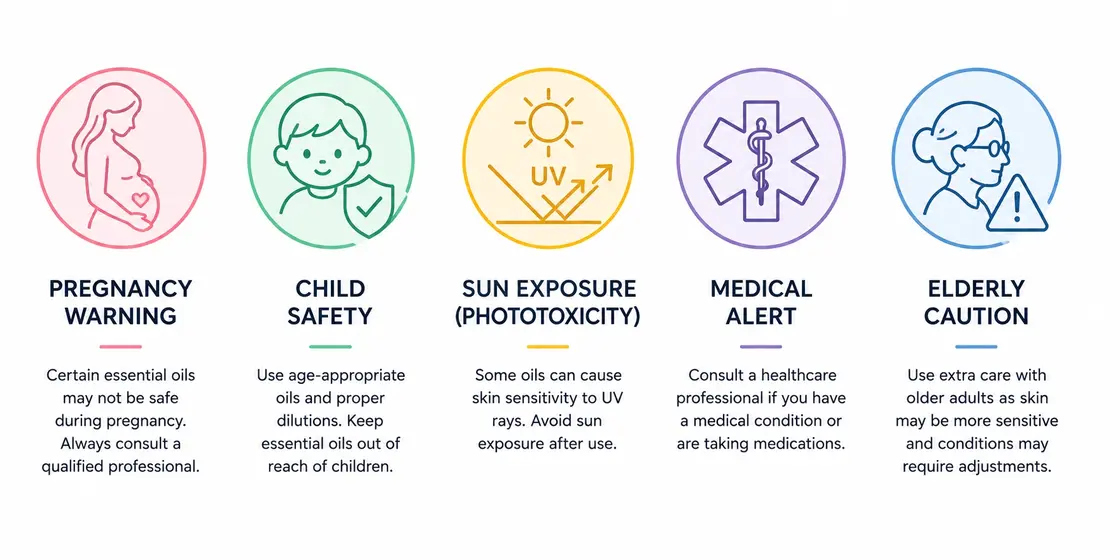
Professional aromatherapy requires rigorous safety knowledge. Misuse of essential oils can cause skin sensitization, toxic reactions, and serious harm. This course emphasizes safe, responsible practice.

| Application | Safe Dilution | Drops per Ounce of Carrier |
|---|---|---|
| Massage (adult) | 2-3% | 12-18 drops |
| Facial application | 0.5-1% | 3-6 drops |
| Bath | 5-8 drops | In carrier oil, not direct |
| Children 2-6 years | 0.5-1% maximum | 3-6 drops |
| Children 6-12 years | 1-2% maximum | 6-12 drops |
| Pregnancy | 1% maximum | 6 drops |
| Elderly/Frail | 1-1.5% maximum | 6-9 drops |
Some citrus oils cause severe sunburn when applied topically before sun exposure. Highly phototoxic oils include bergamot, lemon, lime, grapefruit, and bitter orange (cold-pressed). Avoid sun exposure for 12-24 hours after topical application.
Aromatherapists are NOT medical practitioners. Refer clients to physicians when:
Your $99.99 enrollment includes everything you need to become a certified aromatherapist:
Your $99.99 enrollment covers everything listed above. There are no required textbook purchases, no monthly fees, and no mandatory upsells.
One-time payment. Instant access. No hidden fees.
| Program Type | Typical Cost | Study Format | Course Access |
|---|---|---|---|
| ExpertRating (This Course) | $99.99 | Self-paced online | Lifetime |
| In-person weekend workshop | $400-$800 | 2-3 days intensive | None after class |
| University continuing education | $300-$600 | Scheduled online/campus | Semester only |
| Professional aromatherapy school | $1,200-$3,000+ | Structured program | 6-12 months |
Recover your certification cost quickly:
Some certification programs charge annual renewal fees or membership dues. This certification has none. Pay once, certified for life.
The certification exam tests your knowledge of essential oil safety, chemistry, applications, and professional practice. Here's exactly what to expect:
| Exam Detail | Specification |
|---|---|
| Number of questions | 50 multiple-choice questions |
| Time allowed | 60 minutes (most finish in 30-40 min) |
| Format | Open book - reference course materials |
| Platform | Online, any device, no proctoring required |
| Passing score | 70% (35 out of 50 questions) |
| Attempts included | 3 attempts included in enrollment |
| Results | Instant - know immediately upon submission |
| Average pass rate | 87% on the first attempt |
Real aromatherapists consult reference materials when working with clients. Remembering exact chemical percentages or every contraindication is not realistic - knowing where to find information and how to apply it safely is what matters. The exam tests comprehension and application, not rote memorization.
No pressure. You have 2 more attempts included:
If you need more than 3 attempts, additional exam access costs $20 per attempt. There is no limit on total retakes.
No Renewal Required. Once certified, you're certified for life. No annual fees, no continuing education mandates. Lifetime access to course materials means you can review and refresh your knowledge anytime, even years after certification.
Thousands of students have completed this certification and built successful aromatherapy careers:
If this course does not meet your expectations within the first 30 days, request a full refund. No questions, no hassle, no hard feelings.
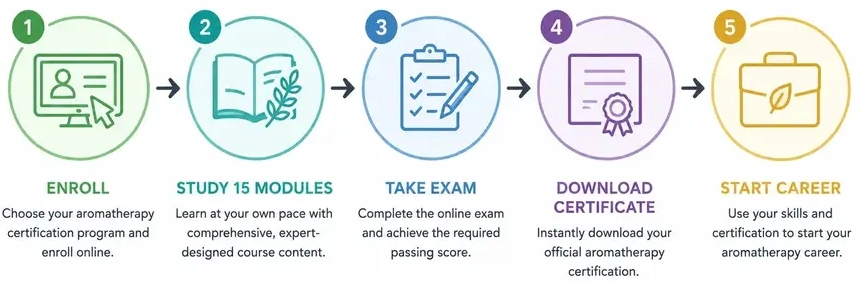
To become a certified aromatherapist, complete an accredited aromatherapy training program that covers essential oil chemistry, safety, therapeutic applications, and professional practice. Study 30+ essential oils in depth, learn contraindications and dilution protocols, understand blending principles, and pass a certification exam.
Optional next steps: Join NAHA, obtain liability insurance, pursue advanced certifications, and start practicing professionally.
Yes, if you plan to practice aromatherapy professionally. Certification builds credibility, demonstrates safety knowledge, and is expected by clients and employers. While aromatherapy is not legally licensed, certification is the industry standard for professional practice.
ROI: Many aromatherapists recover certification cost within 1-2 client sessions or product sales.
With aromatherapy certification, you can work in clinical settings, spas, private practice, or product development. Common career paths include:
This certification typically takes 2-4 weeks to complete when studying 1-2 hours per day. The course is self-paced, so you can finish faster or take more time based on your schedule.
There is no time limit or deadline. Some students complete the course in 1-2 weeks of intensive study. Others take 6-8 weeks while balancing work and family. You have lifetime access, so you can pause and resume anytime.
NAHA (National Association for Holistic Aromatherapy) is the leading professional organization for aromatherapy in North America. NAHA sets education standards, approves schools, and provides professional member benefits.
NAHA membership is NOT required to practice aromatherapy or to take this certification. However, NAHA membership benefits include professional credibility, access to continuing education, liability insurance discounts, and industry networking.
This course introduces foundational aromatherapy concepts that overlap with beginner-level aromatherapy education. However, the course is not advertised as NAHA-approved, NAHA-certified, or equivalent to NAHA Level 1 training. You may choose to join NAHA separately if desired.
Legally, yes - aromatherapy is not a licensed profession in most states, so you can technically practice without certification. However, professional practice without certification is strongly discouraged.
Bottom line: You CAN legally practice in most areas without certification, but you SHOULD get certified for safety, professionalism, and credibility.
There is no aromatherapy license in the United States or most countries. Aromatherapy is not a state-regulated profession like nursing or massage therapy.
Exception: Some states regulate aromatherapy when combined with massage therapy. If you're a licensed massage therapist adding aromatherapy, you practice under your massage license.
Aromatherapist income varies significantly based on employment setting, geographic location, experience, and business model:
| Role / Setting | Typical Income |
|---|---|
| Spa aromatherapist (employed) | $28,000-$45,000/year + tips |
| Clinical aromatherapist | $35,000-$55,000/year |
| Wellness center staff | $30,000-$48,000/year |
| Product formulator | $40,000-$70,000/year |
| Private practice (per session) | $50-$150 per consultation |
| Workshop instructor | $40-$75 per hour |
| Part-time (10-15 clients/month) | $500-$1,500/month |
This course is provided by ExpertRating, an ISO 9001:2015 certified company. ISO 9001:2015 is an international quality management standard ensuring consistent course content, assessment standards, and learner experience.
This is NOT NAHA-approved. NAHA approval requires institutional application and ongoing compliance with NAHA school standards. This course covers NAHA Level 1 equivalent content but is not formally NAHA-approved.
This certification is recognized and accepted by spas, wellness centers, many healthcare facilities for staff education, professional liability insurance providers, and employers in the wellness industry.
Yes, this course is designed for healthcare and wellness professionals including registered nurses (RNs), licensed massage therapists (LMTs), nurse practitioners (NPs), and other licensed providers. No prerequisites required.
Many RNs integrate aromatherapy into holistic nursing practice in hospitals, hospice, palliative care, oncology, and pediatrics. We provide a certificate and transcript showing 30-40 study hours (check with your state board for CE credit acceptance).
LMTs commonly add aromatherapy to massage sessions, charging premium rates. Check with your state board for CE credit acceptance.
If you don't pass on your first attempt, you have 2 additional attempts included in your enrollment. Most students who retake pass on the second attempt.
If you need more than 3 attempts, additional exam access costs $20 per attempt. There is no limit on total retakes. If you are struggling after multiple attempts, contact instructor support for additional study guidance.
Pass rate: 87% of students pass on the first attempt. The exam is open-book, tests comprehension rather than memorization, and covers material clearly explained in the course.
No, you don't need to purchase essential oils to complete this certification. The course teaches aromatherapy theory, chemistry, safety, and applications. You can pass the certification exam without physically handling oils.
Look for suppliers with GC/MS testing reports, botanical names and country of origin listed, and organic or wildcrafted sources when possible.
Complete professional aromatherapy training | 32 essential oils | Safety-certified | Career-ready