A doula provides non-medical support to women and birthing people before, during, and after childbirth. Certification formalizes that support with structured training, recognized credentials, and the professional foundation needed to work with clients, employers, and healthcare teams.
The ExpertRating Doula Certification is an online course and assessment program covering birth physiology, emotional and physical support techniques, prenatal care, obstetric complications, comfort measures, and postpartum doula practice. The course takes 2 to 4 weeks to complete at 1 to 2 hours per day and is available on any device.
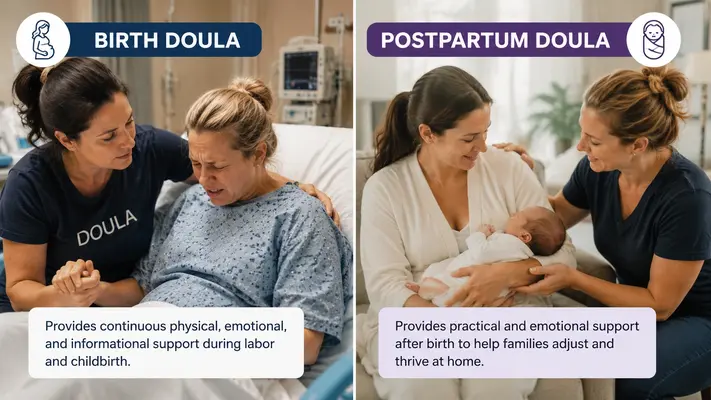
A doula is a trained birth professional who provides continuous physical, emotional, and informational support to a birthing person and their family. Doulas do not perform medical procedures. Their role is to complement the medical team by reducing anxiety, explaining options, and supporting the birthing person throughout labor and the postpartum period.
There are several types of doulas, each focused on a different phase of care:
The World Health Organization (WHO) recommends that women have a companion of their choice throughout labor and childbirth. As trained birth support professionals, doulas provide continuous non-medical emotional, physical, and informational support, helping women and families navigate pregnancy, labor, birth, and the postpartum period with greater confidence and support.
Doula certification involves completing an approved training program and passing a certification assessment. The ExpertRating Doula Certification program covers the following areas:
Course Duration: The course takes most students 2 to 4 weeks to complete at 1 to 2 hours per day.
Certification Exam: After completing the course material, you take the online certification exam from your own device. Passing score allows you to download your certificate immediately.
Sierra Hamm is a baccalaureate-prepared Registered Nurse and Certified Doula with more than a decade of experience supporting women and families through pregnancy, birth, and the postpartum journey.
Her passion for maternal and infant health began after learning about the high rates of maternal and infant mortality in the United States. This calling led her to become a certified doula before earning her Bachelor of Science in Nursing (BSN) from Eastern Kentucky University.
Since then, Sierra has gained hands-on experience across a wide range of birth settings, including a high-volume metropolitan labor and delivery unit with more than 4,000 births annually, a free-standing birth center, and planned home birth environments. This diverse background has given her a comprehensive understanding of childbirth support across both clinical and community-based care settings.
Drawing on her experience as both a nurse and doula, Sierra developed this program to provide accessible, practical, and compassionate doula education. Her goal is to make professional childbirth support training available to people from all backgrounds, helping future doulas gain the knowledge, confidence, and skills needed to support women and families during some of life's most important moments.
Through this course, Sierra shares the principles, techniques, and real-world insights she has gained from years of supporting births and working alongside families, healthcare professionals, and birth teams.
βEvery family deserves compassionate, informed support during pregnancy, birth, and the postpartum period. My goal is to help aspiring doulas develop the confidence and skills needed to make a meaningful difference in the lives of the families they serve.β
β Sierra Hamm, BSN, RN
Explore the comprehensive curriculum designed to prepare you for supporting families through pregnancy, childbirth, and the postpartum journey. Each module combines practical skills, professional standards, and real-world doula knowledge.
Introduction to the course, certification requirements, and completing your program successfully.
Understand the role of doulas, job outlook, course expectations, and key concepts.
Core principles, scope of practice, advocacy, informed consent, and professional standards.
Learn empathy, active listening, affirmations, confidence-building, and community referrals.
Comfort measures, relaxation, positioning, breathing techniques, massage, hydrotherapy, and more.
Evidence-based information, communication skills, community resources, and client empowerment.
Labor stages, birth physiology, hormones, pushing techniques, placental delivery, and bonding.
Medical interventions, inductions, cesarean birth, fetal monitoring, analgesia, and newborn care.
Effective prenatal meetings, birth planning, client history, and preparing for labor.
Newborn care, feeding, safe sleep, postpartum recovery, and family support.
Set goals, find opportunities, build your practice, and grow your doula career.
A birth doula certification qualifies you to provide labor support. Training covers the physiology of labor, pain management without medication, obstetric interventions, and how to support both the birthing person and their birth partner effectively. Birth doulas typically work with clients from the third trimester through delivery and immediate postpartum.
The ExpertRating Doula Certification curriculum covers birth doula responsibilities in the Intrapartum: Labor and Birth, Physical Support, and Common Interventions modules.
Postpartum doulas support families in the first days and weeks after birth. Responsibilities include newborn care guidance, breastfeeding and lactation support, maternal recovery support, sibling adjustment, and mental health awareness. Postpartum doulas often work hourly, with many providing overnight support.
The ExpertRating curriculum covers postpartum care in the Postpartum Doula Care module, which includes breastfeeding basics, infant soothing, and practical family support.
Community doulas work within specific geographic or cultural communities - often serving underrepresented populations with higher rates of maternal and infant health disparities. Many community doula programs operate through partnerships with state health departments, hospitals, and federally qualified health centers.
As of 2024 and 2025, a growing number of U.S. states have expanded Medicaid coverage to include doula services. If you intend to work within a state Medicaid program, you should verify current coverage and requirements directly with your state Medicaid office, as requirements and reimbursement rates vary and may have changed. This is general information - verify current state coverage before making any career decisions based on it.
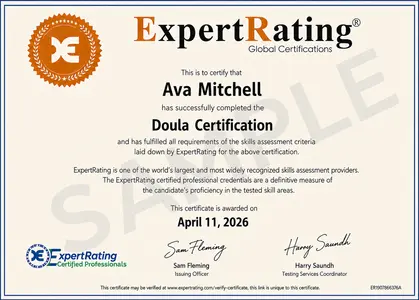
Certification provides a formal record of your training and competency. For clients, it signals that you have completed structured education and met an established standard. For employers, hospitals, and birth centers, it provides a verifiable credential they can check.
Specific reasons people pursue doula certification:
Certification does not constitute licensure. Doulas do not hold medical licenses and do not perform clinical procedures. If you are seeking state licensure for a healthcare role, you should verify whether a doula certification satisfies any state-specific requirements directly with the relevant licensing body.
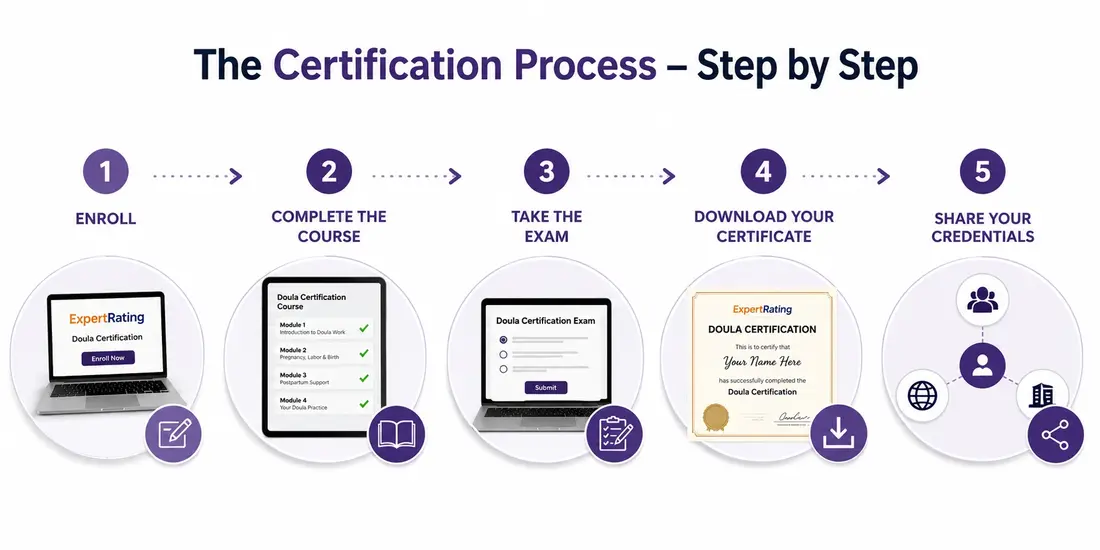
Enroll in the ExpertRating Doula Certification course. The fee is $99.99, all-inclusive, covering courseware and exam.
Complete the online course modules at your own pace. Most students finish in 2 to 4 weeks at 1 to 2 hours per day. You can start immediately after enrollment and access course material from any device.
Take the online certification exam when you are ready. The exam can be taken from your own device. If you do not pass, you may re-attempt the exam for $20, up to three times.
Download your digital certificate immediately upon passing. Your certificate is issued in your name and includes an online transcript showing your exam score.
Share your credentials. Your certificate can be shared with employers, clients, and professional networks. ExpertRating responds to employer and client verification requests. Your certification is valid for one year and can be renewed for $30.
There are no prerequisites for this course. You need internet access, an email address, and a web browser to participate.
As awareness of maternal health, birth support, and postpartum care continues to grow, demand for trained doulas has increased across many communities. More families are seeking continuous emotional, physical, and informational support during pregnancy, labor, birth, and the postpartum period, creating opportunities for trained birth doulas and postpartum doulas to serve a wide range of clients.
A doula career can be flexible and rewarding. Some certified doulas work independently, while others provide services through birth centers, community organizations, healthcare programs, or maternal health initiatives. Many professionals begin offering doula services on a part-time basis and expand their practice as they gain experience and build referrals.
Compensation for doulas varies significantly depending on location, experience, specialization, services offered, and local market conditions. Birth doulas may structure their fees differently from postpartum doulas, and rates can vary considerably between regions. Because the U.S. Bureau of Labor Statistics does not publish dedicated wage data for doulas, prospective doulas should research local market rates, professional associations, and industry surveys when evaluating earning potential.
A college degree is not generally required to become a doula. Professional certification is one of the most common ways doulas demonstrate their training, knowledge, and commitment to professional standards. Certification can help prospective clients, employers, and community organizations understand that you have completed structured doula training and successfully demonstrated competency through assessment.
Many certified doulas build successful practices through referrals, relationships with healthcare providers, birth centers, community organizations, and professional directories. Others use their doula training to complement existing careers in healthcare, education, social services, childcare, or maternal wellness.
Whether your goal is to support families part-time, build an independent doula practice, or expand your existing professional skills, doula certification provides a strong foundation for working with women and families during pregnancy, childbirth, and the postpartum journey.
The ExpertRating Doula Certification is recognized by private employers and organizations across the U.S. and other countries. ExpertRating is an ISO 9001:2015 certified company, which means the organization's training and assessment processes conform to international quality management standards.
To verify an ExpertRating certification, employers and clients can contact ExpertRating directly. The certificate includes an online transcript that displays the exam score and certification date.
ExpertRating is an ISO 9001:2015 certified company providing online professional certifications and assessments to individuals and employers globally. The company has processed certifications for over 25 million people across 160 countries and delivers training services to companies including Walmart, IKEA, GAP, Ericsson, and Dell, among others.
The ExpertRating Doula Certification courseware was developed and reviewed by experienced professionals in the field. Course content is updated to align with current evidence-based birth practices. If you would like to understand the credentials of the curriculum authors, contact ExpertRating directly for author information.
The certification program uses secure, encrypted assessment delivery via a Positive SSL-protected environment. Payment is processed through PayPal, a PCI-compliant payment platform, with over 200,000 sales verified. All major credit cards are accepted.
Note: ExpertRating does not provide supervised clinical hours, live birth attendance requirements, or mentorship pairing as part of this certification program. These are elements of some other doula certification programs. Review your specific career goals before enrolling.
Professional doula practice does not end with certification. As a certified doula, you will continue to grow your skills through experience, peer support, and formal continuing education.
The ExpertRating Doula Certification is valid for one year. Renewal costs $30 and provides an updated certificate.
Annual renewal fee for an updated certificate
Most students complete the ExpertRating Doula Certification in 2 to 4 weeks at 1 to 2 hours of study per day. There is no fixed deadline - you study at your own pace and take the exam when you feel prepared.
The exam tests your knowledge of the course content, including doula roles and responsibilities, labor physiology, emotional and physical support techniques, postpartum care, and obstetric complications. Sample questions are available within the course for practice.
ExpertRating certifications are recognized by private employers across the U.S. and internationally. The company responds to hundreds of employer and client verification requests annually. However, ExpertRating is not affiliated with DONA International, CAPPA, or other doula-specific certification boards. If a specific employer or Medicaid program requires certification from one of those organizations, this certification may not qualify. Verify your specific employer's requirements before enrolling.
A birth doula provides support during labor and delivery. A postpartum doula provides support after birth, during the recovery period, including newborn care guidance, breastfeeding support, and maternal wellbeing. Some doulas are trained and certified in both areas.
No. There are no prerequisites for the ExpertRating Doula Certification. You need an internet connection, an email account, and a web browser. No prior medical training or degree is required.
There is no single legally required certification for doulas in most countries, including the United States. However, professional certification through recognized programs (such as DONA International, CAPPA, ExpertRating, or others) demonstrates trained competency to clients and employers. Requirements vary if you seek work within a hospital system, birth center, or state Medicaid doula program - in those cases, the employer or program may specify which certification they accept.
ExpertRating certifications include an online transcript with the exam score and certification date. Employers and clients can verify certifications by contacting ExpertRating directly through the website. The certificate itself does not include the word 'online,' which means it can be used to demonstrate certified status professionally.
The ExpertRating Doula Certification is valid for one year. You can renew by paying a $30 renewal fee, after which you receive a new downloadable PDF certificate. Your study material remains accessible after completing the certification.
A growing number of U.S. states have expanded Medicaid to cover doula services as of 2024β2025, including California, Oregon, Minnesota, and others. Reimbursement rates, covered doula types, and certification requirements differ by state. If you plan to work as a Medicaid-covered doula, verify current coverage and any specific certification requirements with your state Medicaid program directly. State policies change and this information may not reflect the current status in your state.
You can re-attempt the certification exam for $20 per attempt, up to three times. Most students who review their course material before retesting are successful on a second attempt.
Begin immediately, study at your own pace, and earn a professional credential you can share with employers and clients.
Get Certified TodayNot ready to enroll? Download the free course overview to review the full syllabus before you decide.
Download Course Overview