Root Cause Analysis Course
Treat the Cause, Not the Symptoms
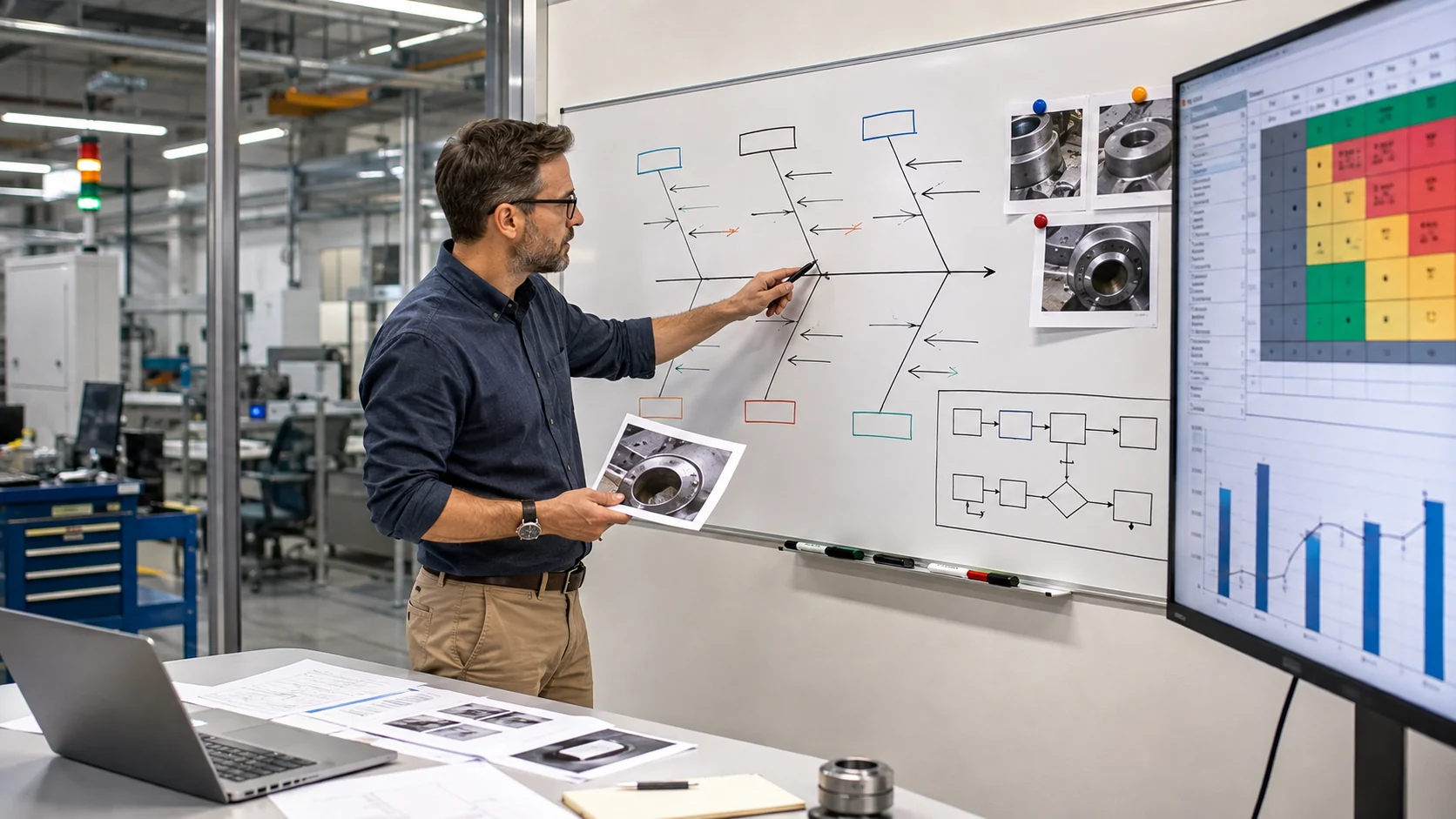
ExpertRating's Root Cause Analysis Course teaches you the structured methodology and recognized tools, including Fishbone Diagrams, 5 Whys, and FMEA, to identify the real source of a quality problem instead of patching its symptoms.
Learn how to perform failure analysis without assumptions, assess severity, occurrence, and detection, and design corrective and preventive actions that actually hold.
Just $99.99, one-time payment, lifetime course access
Certification
Why Root Cause Analysis Matters for Quality Professionals
Most quality problems get fixed twice: once on the surface, and once for real. Surface fixes feel productive, but if the underlying cause is never identified, the same defect, the same near-miss, the same customer complaint comes back, usually at a worse time and a higher cost. Root cause analysis is the discipline that closes that gap. It is a foundational practice across ISO 9001-aligned quality management systems and Total Quality Management programs, and it is one of the most transferable skills a quality professional can hold, because every industry that manufactures, ships, or delivers anything eventually has to answer the question: why did this actually happen?
This course gives you a repeatable, evidence-based process for answering that question instead of guessing. You will learn to separate causal factors from coincidence, quantify severity and likelihood the way a formal FMEA does, and translate findings into corrective and preventive actions (CAPA) that hold up under audit, not just intuition that sounds reasonable in a meeting.
On the numbers: the U.S. Bureau of Labor Statistics reports a median annual wage of $101,140 for industrial engineers as of May 2024, with employment projected to grow 11 percent from 2024 to 2034, much faster than average. Role-specific data for root cause analyst positions from Glassdoor shows a typical range of roughly $69,000 to $125,000 annually depending on experience and industry. Whether you support quality assurance, process improvement, operations, safety, or compliance, stronger investigative skills can help you approach recurring problems with greater structure and confidence.

Curriculum
Inside the Course: Curriculum and Methodology
The course follows a structured investigative sequence, from analyzing failures and assessing risk to selecting corrective or preventive solutions that support lasting process improvement.
Each substantive chapter includes summaries, key terms, self-study descriptive and multiple-choice questions, answer keys, supporting resources, and, where specified, practical examples or case studies.
| Module | Focus | What You Will Learn |
|---|---|---|
| 1. Preface and Certification Program | Course orientation | An overview of the Root Cause Analysis Certification Program, the author, course structure, and final certification test. |
| 2. Introduction to Root Cause Failure Analysis | RCA foundations | How failures create operational obstacles, how the FMEA approach supports failure analysis, and the difference between temporary correction and permanent prevention. The chapter also introduces the journey toward zero defects. |
| 3. Failure Analysis Without Assumptions | Business and process improvement | How failure analysis can support wealth creation, process improvement, and better customer outcomes. Examples and case studies reinforce the practical application of these concepts. |
| 4. Analysis of Process | Process and failure modes | The five elements of a process, statistics associated with business failure, and how failure modes can be examined within a process. |
| 5. Severity of Failure | Failure effects and severity | How to examine the effects, severity, and causes of failure as part of a structured root cause analysis and risk evaluation process. |
| 6. Occurrence of Failure | Failure frequency and controls | How to examine incidents of failure and evaluate the current process controls used to manage or reduce their occurrence. |
| 7. Detection of Failure | Process capability and detection | How process capability measures such as Cp and Cpk relate to detection ranking, along with the limitations and potential pitfalls of relying on inspection. |
| 8. Risk Assessment | Risk prioritization | How response thresholds and the Risk Priority Number, or RPN, can help prioritize failures based on risk. The chapter also considers how failures affect suppliers and customers. |
| 9. Solution: Correction or Prevention | Selecting an appropriate response | How to evaluate solutions using relative risk, cost, time, and return on investment, and how to decide between correcting an existing problem and preventing its recurrence. |
| 10. The Leap from Chaos to Control | Records and continuous improvement | Why accurate record keeping matters and how the Six Sigma continuous improvement cycle can help organizations move from recurring failures toward greater process control and value creation. |
Tools
Recognized Tools and Frameworks
Move beyond theory with structured methods for analyzing failures, assessing risk and selecting an appropriate response. The Root Cause Analysis Course introduces practical concepts used in quality management, process improvement and failure prevention.
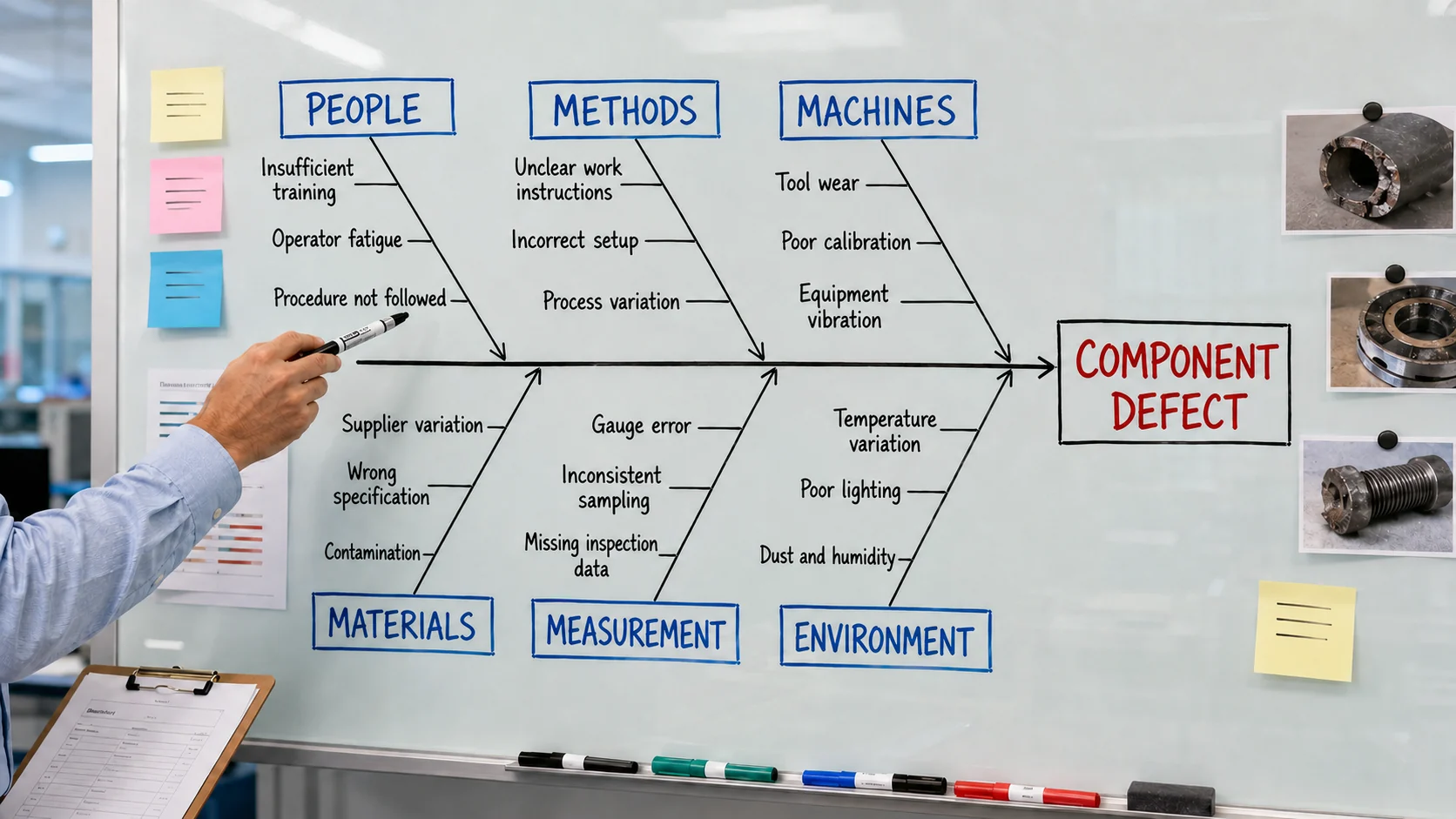
Fishbone Diagram (Ishikawa)
A visual method for organizing potential causes of a problem into categories, helping investigation teams see the full causal landscape before jumping to a conclusion.
5 Whys
A simple but rigorous technique of repeatedly asking “why” to move past the first, most obvious explanation and reach the actual root cause.
FMEA (Failure Mode and Effects Analysis)
Explore the Failure Mode and Effects Analysis approach to identifying failure modes and examining their potential effects, causes and associated risks.
CAPA (Corrective and Preventive Action)
The documentation and action framework that turns a root cause finding into a verified, auditable fix, a core requirement in regulated industries.
Severity, Occurrence and Detection
Learn how severity, occurrence and detection contribute to a structured evaluation of failure risk. These factors help quality professionals understand the impact of a failure, how often it may occur and how effectively existing controls can detect it.
Process Capability: Cp and Cpk
Examine how the process capability indices Cp and Cpk relate to process performance and detection ranking, along with the limitations of relying solely on inspection.
Industry
Where Root Cause Analysis Is Used
Root cause analysis is a widely used problem-solving discipline across industries where defects, failures, incidents and service disruptions create cost, safety or compliance risks.
The Root Cause Analysis Certification Course introduces principles that can be applied across quality assurance, manufacturing, engineering, operations, safety and continuous improvement roles.
Manufacturing and Industrial Operations
Manufacturing facilities rely on root cause analysis to resolve recurring production defects, equipment failures, process variation, quality-control problems and reduce cost of quality.
Medical Devices and Pharmaceuticals
Medical-device and pharmaceutical organizations use cause investigation within quality systems addressing nonconformities, product complaints, deviations and corrective actions.
Aviation, Rail, and Defense
Transportation investigators and safety teams analyze evidence to determine the causes and contributing factors associated with accidents, equipment failures and other safety events.
Oil and Gas, Food and Beverage, and Occupational Safety
Process-heavy and safety-regulated industries use root cause analysis to investigate equipment failures, contamination events, process deviations, and workplace incidents.
Information Technology and Telecommunications
IT, cybersecurity and telecommunications teams use root cause analysis to investigate outages, recurring service incidents, system failures and security events.
A Transferable Approach to Problem-Solving
Although terminology and regulatory requirements vary between industries, the central objective remains consistent: understand why a failure occurred, assess its risk and make a better-informed decision about correction or prevention.
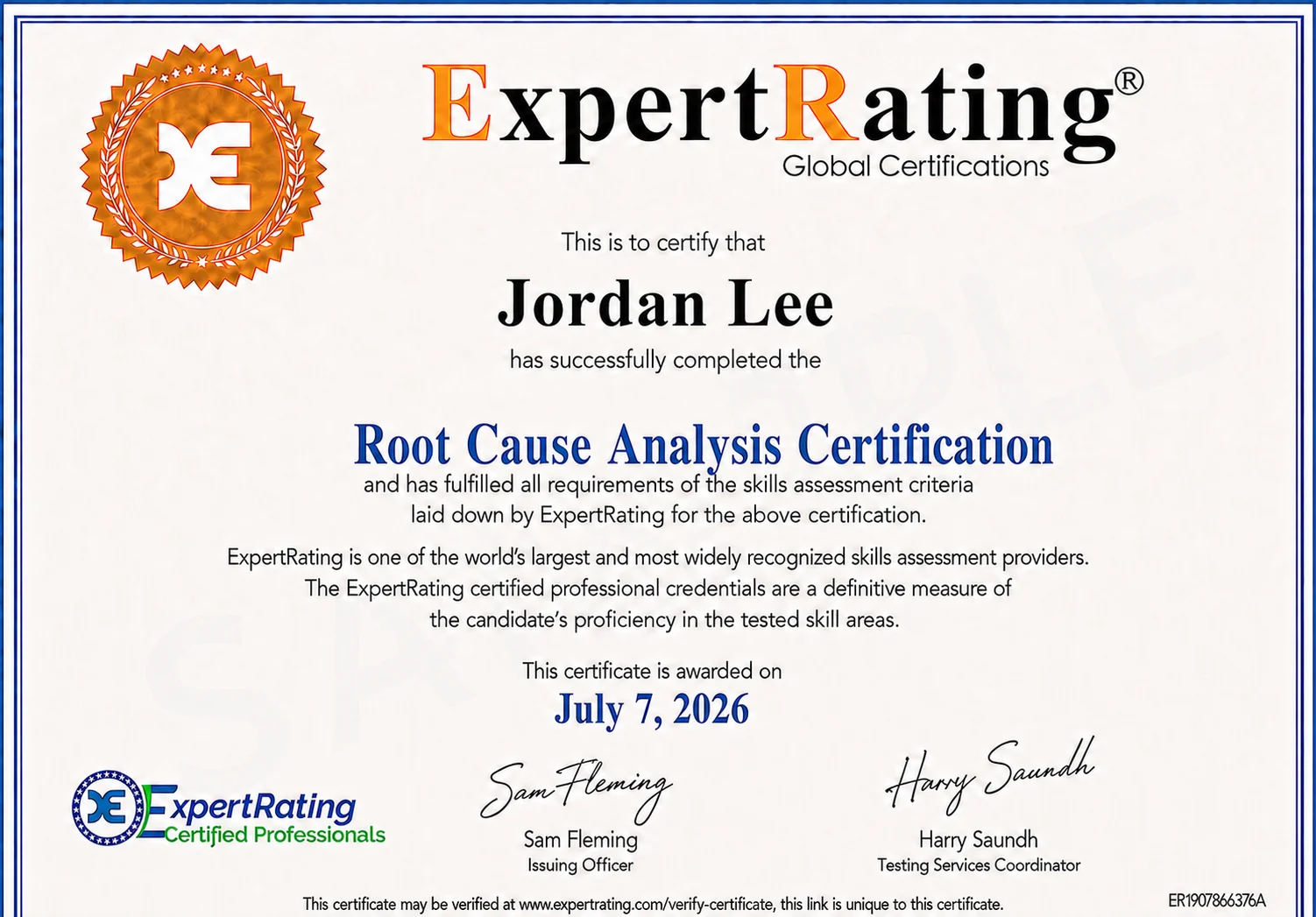
Certification
Certification Exam Specification
| Detail | Specification |
|---|---|
| Format | Online, multiple choice questions, taken from your own device at a time of your choosing. |
| Time to complete course | 2 to 4 weeks at 1 to 2 hours of study per day, self-paced. |
| Access window | One year from date of purchase to complete the course and sit the exam. |
| Retake policy | Up to three retake attempts if you do not pass, for a $20 fee per retake. |
| Certificate format | Downloadable digital certificate and online transcript; physical hard copy certificate available for an additional fee. |
| Renewal | Renewable after one year for a $30 fee, with a new downloadable certificate issued. |
| Course access after completion | Full study material remains accessible after you complete the course. |
Value
Pricing Comparison
Root cause analysis training ranges from a self-paced online course to multi-day, instructor-led programs costing well into four figures. Here is how ExpertRating compares.
| Provider | Price | Format |
|---|---|---|
| ExpertRating Root Cause Analysis Course | $99.99 one-time | Fully online, self-paced, lifetime access to course material. |
| TapRooT Root Cause Analysis Training (2 to 5 day programs) | Several hundred to over a thousand dollars per attendee, depending on program length | In-person, virtual, or self-guided e-learning; instructor-led with team exercises. |
| ASQ Root Cause Analysis Course (live virtual or in-person) | Premium pricing, contact ASQ for current rate | Instructor-led virtual or classroom training; ASQ CEUs and recertification units available to members. |
Trust
Why ExpertRating
- ISO 9001:2015 certified company, demonstrating compliance with internationally accepted quality management standards.
- Member of the Institute for Credentialing Excellence (I.C.E.), adhering to quality assurance and ethical practice benchmarks.
- Trustpilot rating of 4.7 out of 5 based on 1,342 reviews.
- Trusted by more than 6,500 companies worldwide, including IKEA, Walmart, Dell, Gap, Ericsson, L'Oreal, and Amadeus, for training and testing needs.
- Over 25 million people certified globally since 2001.
Testimonials
Testimonials
“The Root Cause Analysis certification provides objective proof of my abilities and shows that I can identify system failures and help improve processes.”
Patrice Perry✓ Verified
“The certification strengthened my credibility as an RCA instructor and provided valuable insight into accident and failure analysis.”
Kevin Sorbello✓ Verified
“This course helped me identify the root causes of warehouse damage and reduce the associated costs.”
Isabelle Wilkins✓ Verified
“The course helped me perform root cause analysis for audit nonconformities, nonconforming products, corrective actions, and customer complaints.”
Emile Ghorayeb✓ Verified
“My certification has directly supported my responsibilities as a Safety Officer and helped me make workplaces safer.”
Chris Chandler✓ Verified
“The certification improved my understanding of RCA techniques and their practical application to equipment failures and maintenance planning.”
Gary Fields✓ Verified
FAQ
Frequently Asked Questions
Accreditation
Accreditation and Quality Assurance
ExpertRating is an internationally recognized provider of online certification and professional training programs. The organization is ISO 9001:2015 certified, demonstrating compliance with internationally accepted quality management standards.
As a member of the Institute for Credentialing Excellence (I.C.E.), ExpertRating adheres to defined benchmarks for quality assurance, ethical practice, and continuous improvement.
Start Solving Quality Problems at the Root
Join thousands of quality professionals who have used ExpertRating's Root Cause Analysis Course to move from chaos to control. Lifetime access, $99.99, one payment.
Buy Now