ExpertRating's Stretching and Flexibility Certification gives you the science, the techniques, and the special-population programming skills to add stretch coaching to your fitness career, or build a stretch-focused practice from the ground up.
Learn static, dynamic, and PNF stretching techniques, the anatomy and science behind flexibility, and how to safely program for general fitness clients, athletes, older adults, and clients with chronic pain or special needs.
Stretching and flexibility training are becoming more valuable skills for today’s fitness professionals. Clients are no longer looking only for strength or cardio workouts. Many also want better mobility, improved range of motion, recovery support, posture awareness, and safer movement for everyday life, sports, and active aging.
That demand creates a clear opportunity for trainers who can do more than lead a basic cool-down. A Stretching and Flexibility Certification helps fitness professionals learn how to assess client needs, choose appropriate static, dynamic, passive, and PNF stretching techniques, and adapt flexibility programming for general fitness clients, athletes, older adults, and special populations.
12 percent from 2024 to 2034
74,200 openings projected each year
$46,180 in May 2024
$82,050
The broader fitness career outlook supports this opportunity. According to the U.S. Bureau of Labor Statistics, employment of fitness trainers and instructors is projected to grow 12 percent from 2024 to 2034, much faster than the average for all occupations, with about 74,200 openings projected each year. The median annual wage for fitness trainers and instructors was $46,180 in May 2024, while the highest 10 percent earned more than $82,050.
For personal trainers, group fitness instructors, yoga professionals, Pilates instructors, massage therapists, and wellness coaches, adding structured stretch coaching can help expand service offerings, improve client retention, and create a stronger value proposition in a competitive fitness market.
A Stretching and Flexibility Certification can support several fitness and wellness career paths, whether you are starting a new career in fitness or adding a focused specialization to an existing role. As more clients look for mobility, recovery, better range of motion, and guided stretching support, professionals who can deliver structured flexibility programming can stand out in a competitive market.
Work one-on-one with clients in their homes, in a private studio, or through a mobile stretch-coaching service. Assisted stretching has become a growing service model, with national brands offering one-on-one and group stretch sessions for clients who want improved flexibility, mobility, and recovery support.
If you are already a personal trainer, this certification can help you add structured flexibility coaching to your service menu. You can use stretch sessions as a standalone service, a recovery-focused add-on, or part of a complete fitness program that includes strength, cardio, mobility, and flexibility work.
Lead dedicated stretch, mobility, and recovery classes at gyms, fitness studios, wellness centers, and corporate wellness programs. These lower-impact class formats can appeal to clients who want better movement quality, improved posture awareness, and a more accessible way to stay active.
Massage therapists, yoga instructors, and Pilates instructors can use a Stretching and Flexibility Certification to deepen their understanding of stretch physiology, range-of-motion assessment, static stretching, dynamic stretching, passive stretching, and PNF stretching techniques. This can help them offer more structured, assessment-based flexibility guidance within the scope of their existing training and professional role.
The course is organized into focused modules that take you from foundational science through real-world programming for every client type.
Course orientation
Introduction to the certification, course structure, author background, and final certification test overview.
Foundations
The definition of stretching, the difference between stretching and flexibility, examples of stretching, the focus of the certification, and key stretching terms.
Anatomy and physiology
How muscles and bones work together, muscle fibers and contractions, elasticity, muscle fiber types, and what happens in the body during a stretch.
Technique
Static stretching, dynamic stretching, PNF stretching, and ballistic stretching, including the purpose and appropriate use of each method.
Critical thinking
Common stretching misconceptions, including warming up before stretching, stretching frequency, post-workout stretching, muscle-specific stretching, and the belief that stretching decreases performance.
Outcomes
How stretching may support flexibility, range of motion, reduced soreness, injury-risk reduction, and broader wellness goals.
Programming
How to discuss stretching with general fitness clients, including clients focused on fat loss, weight loss, muscle building, endurance, and complete fitness programming.
Sports performance
Stretching considerations for athletic clients, including when stretching may or may not be appropriate and how to apply acute variables for athletic programs.
How to modify stretching guidance for obese clients, elderly clients, and clients with chronic pain.
How to modify stretching guidance for pregnant clients, clients with chronic illness, and teenagers.
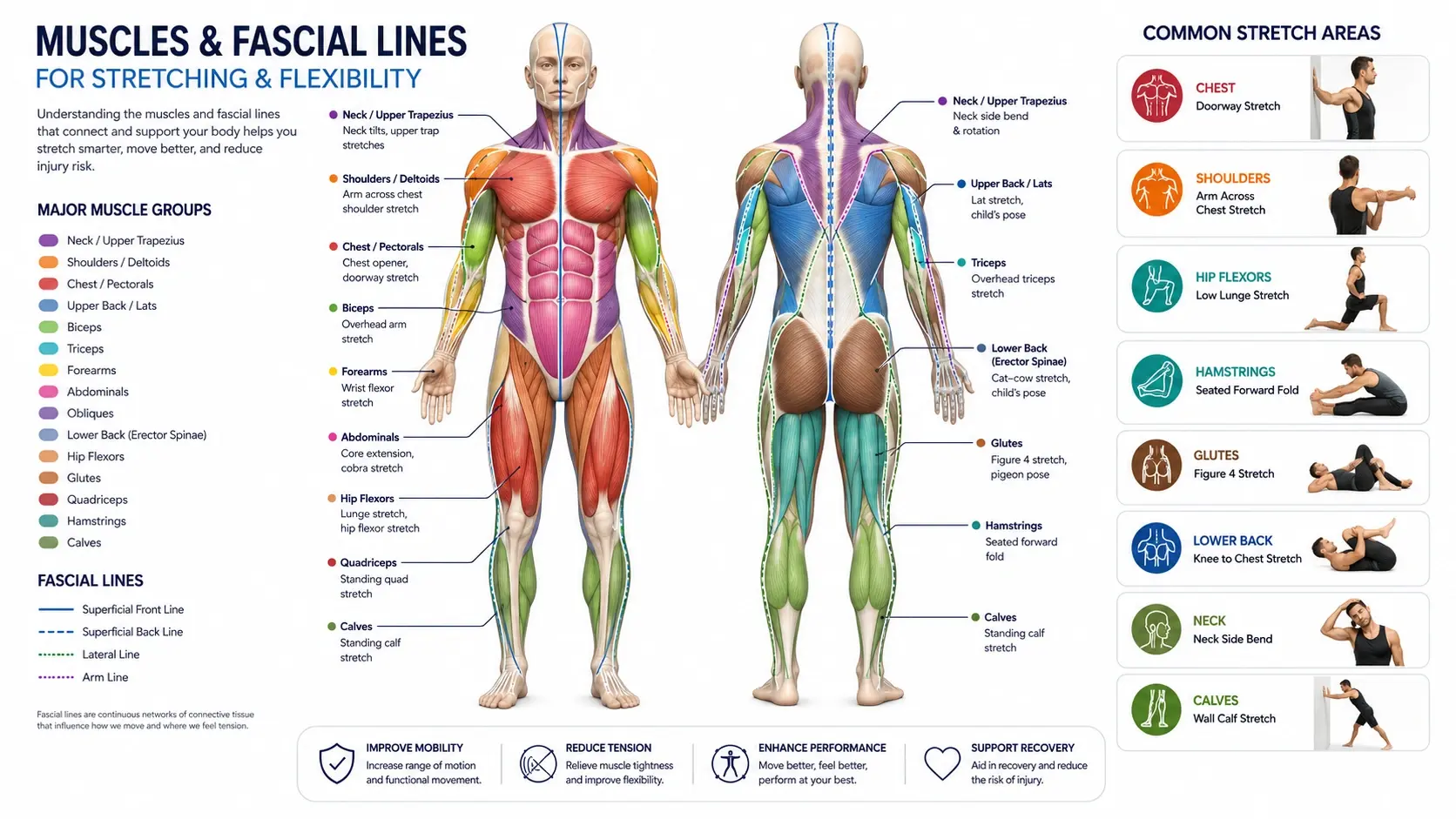
Step-by-step stretches organized by major muscle group, including chest, upper back, lower back, shoulders, neck, quadriceps, hamstrings, calves, glutes, triceps, biceps, wrists, abdominals, and obliques.
Effective stretch coaching starts with understanding what happens inside the body during a stretch. The Stretching and Flexibility Certification introduces the muscle, joint, and nervous-system concepts that help fitness professionals choose safer, more effective stretching techniques for different clients.
Fascia is connective tissue that helps surround, separate, and support muscles and other body structures. Healthy connective tissue, muscle elasticity, and consistent movement all play a role in how freely a client can move. In this course, you learn how stretching fits into a complete flexibility program and how muscle tissue responds during static, dynamic, PNF, and ballistic stretching.
Flexibility is not only about “lengthening” a muscle. It also involves the nervous system. Muscle spindles help detect stretch and contribute to protective reflex responses, while Golgi tendon organs help monitor muscle tension. Understanding these basic mechanisms helps a stretch coach cue clients more effectively, avoid forcing a stretch, and progress range of motion with better control.
Range of motion is one of the most important outcomes of a flexibility program. The course explains how stretching may support improved flexibility, better movement quality, reduced soreness, and appropriate programming for general fitness clients, athletic clients, and special populations. You also learn practical stretches organized by major muscle group, including chest, back, shoulders, neck, quadriceps, hamstrings, calves, glutes, arms, wrists, abdominals, and obliques.
A valuable strength of the Stretching and Flexibility Certification is its focus on applying stretching techniques to different client types. The syllabus includes dedicated chapters on general fitness clients, athletic clients, and special populations, helping students understand how stretching may need to be modified based on client goals, comfort level, mobility, and professional scope.
Stretch programming for everyday fitness goals, mobility, flexibility, and overall movement quality.
Programming adjustments for sport demands, performance, warm-up, and recovery.
Safe flexibility programming for clients with unique mobility, comfort, and health considerations.
| Population | Key Consideration | Programming Adjustment |
|---|---|---|
| Older clients | Balance, comfort, mobility level, and possible age-related changes in flexibility | Use a longer warm-up, gentler stretch progression, and seated or supported positions where appropriate. |
| Obese clients | Comfort, positioning, joint stress, and individual range-of-motion needs | Modify positions, prioritize safe setup, and focus on functional range of motion rather than maximal stretch depth. |
| Chronic pain clients | Pain sensitivity, comfort, confidence, and scope of practice | Use conservative progressions, frequent check-ins, and refer or coordinate with a healthcare provider when pain, medical restrictions, or unclear symptoms are present. |
| Pregnant clients | Positioning, comfort, joint laxity, and exercise modifications during pregnancy | Avoid aggressive stretching, avoid prolonged supine positions later in pregnancy, and use pregnancy-safe modifications within the client's healthcare guidance. |
| Clients with chronic illness | Energy level, symptoms, medical restrictions, and exercise tolerance | Use gentle, individualized programming and recommend medical clearance when needed. |
| Teenagers | Age-appropriate intensity, technique, coordination, and body awareness | Use lower-intensity stretches, teach proper form, and emphasize control over depth of stretch. |
| Athletic clients | Sport demands, training phase, warm-up needs, and recovery goals | Use dynamic stretching before activity when appropriate, and use static stretching or PNF-style flexibility work after training or in separate recovery sessions when suitable. |
| Detail | Specification |
|---|---|
| Format | Online, taken from your own device at a time of your choosing. |
| Time to complete course | 2 to 4 weeks at 1 to 2 hours of study per day, self-paced. |
| Access window | One year from date of purchase to complete the course and sit the exam. |
| Retake policy | Up to three retake attempts if you do not pass, for a $20 fee per retake. |
| Certificate format | Downloadable digital certificate and online transcript; physical hard copy certificate available for an additional fee. |
| Renewal | Renewable after one year for a $30 fee, with a new downloadable certificate issued. |
| Course access after completion | Full study material remains accessible after you complete the certification. |
Stretch and flexibility certifications vary widely in price. Here is how ExpertRating compares to other recognized providers in this category.
| Provider | Price | Format |
|---|---|---|
| ExpertRating Stretching and Flexibility Certification | $99.99 one-time | Fully online, final test fee and continued access to study material after completion. |
| NASM Stretching and Flexibility Coach | $399 one-time, or $34/month over 11 months | Fully online, self-paced specialization. |
| Independent stretch-certificate providers (e.g. Stretching Institute) | Premium pricing, typically several hundred dollars | Online, self-paced, includes CEU recognition from multiple bodies. |
| StretchLab Flexologist Training Program | Not publicly listed; requires in-person component | Blended online and in-person (50 to 70 hour proprietary program). |
David J. Sautter is a certified fitness professional and experienced fitness educator with credentials from NASM and ACE. As a NASM Certified Personal Trainer, NASM Fitness Nutrition Specialist, NASM Performance Enhancement Specialist, and ACE Sports Conditioning Specialist, David combines practical training knowledge with a strong foundation in exercise science, biomechanics, performance coaching, and client motivation.
David has trained hundreds of clients, conducted fitness workshops, and written hundreds of fitness articles, guides, and educational resources for major health and fitness audiences. His work focuses on making complex fitness concepts clear, practical, and easy to apply.
In this Stretching and Flexibility Certification, David helps students understand the science behind stretching, the role of flexibility in complete fitness programming, and how to apply stretching techniques for general fitness clients, athletic clients, and special populations.
This course reflects David’s core teaching style: practical, evidence-informed, and built for fitness professionals who want to turn knowledge into confident real-world coaching.
ISO 9001:2015 certified company, demonstrating compliance with internationally accepted quality management standards.
Member of the Institute for Credentialing Excellence (I.C.E.), a professional association for the credentialing community, adhering to quality assurance and ethical practice benchmarks.
Trusted by more than 6,500 companies worldwide, including IKEA, Walmart, Dell, Gap, Ericsson and Amadeus, for training and testing needs.
Over 25 million people certified globally since 2001.
ExpertRating - Real Reviews from Real Students
See what our students are saying about their certification experience.
“ This certification has helped me with the senior citizen population. It is very important to warm up, stretch, and improve balance. I do this before my seniors do their strength training. My employer is pleased that I hold this certification. It has enhanced my personal training career.
“ I teach a weekly group fitness class to adults that features stretch and flexibility. It gave me the skills and knowledge I needed to teach the class.
“ ExpertRating has helped me learn how to offer modifications in my group fitness classes so that my clients can modify their workouts as needed. Working with 55+, this has been invaluable. My ExpertRating certifications have also helped me teach a variety of fitness levels.
“ The Expert Rating training course laid the foundation and gave me the knowledge to pursue a career in providing safe, functional fitness activities to the senior population. It has given me the confidence to work with this special population.
“ Learned proper technique for stretches. Learned many good stretches for seniors.
“ ExpertRating has helped me by giving me the tools I need to help my clients move toward a healthier and more functional way of life. It’s given me the confidence to lead my own clients through strength training routines and stretching sessions, leaving them feeling amazing.
ExpertRating is an internationally recognized provider of online certification and professional training programs. The organization is ISO 9001:2015 certified, demonstrating compliance with internationally accepted quality management standards.
As a member of the Institute for Credentialing Excellence (I.C.E.), ExpertRating adheres to defined benchmarks for quality assurance, ethical practice, and continuous improvement.
ExpertRating's ISO 9001:2015 certification and I.C.E membership relate to the organization's quality management and educational standards practices. They are not equivalent to programmatic accreditation from a body such as the National Commission for Certifying Agencies (NCCA). No NCCA or equivalent programmatic accreditation is claimed for this certification on this page.
Join thousands of fitness professionals who have added stretch coaching to their career with ExpertRating's Stretching and Flexibility Certification. Lifetime access, $99.99, one payment.